
Psychiatric progress reports, drafted from the referral letter and the diagnosis.
ATTEND is clinical documentation software for psychiatry practices. It completes your own report templates — progress reports, hospital admission reports, medical-scheme forms — from the two documents you already have, leaves every field editable, and learns from the corrections you make.
Where the hours go
Every admitted patient, every week
A psychiatry practice writes the same progress report, in the same structure, for every admitted patient every week — plus an admission report at admission and the medical scheme's own form for each funded stay. The content is clinical judgement. The typing is not.
The same two sources
Almost everything on those forms is already in the referral letter and the doctor's diagnosis: the patient's details, the history, the presenting problem, the code the scheme authorises against. ATTEND reads those two documents and does the typing.
What ATTEND does
Drafts
From the referral letter and the doctor's diagnosis, ATTEND completes the practice's own templates: numbered progress reports, hospital admission reports and medical-scheme admission forms. The referral letter is read by ATTEND itself, not sent to a third-party service.
Keeps everything editable
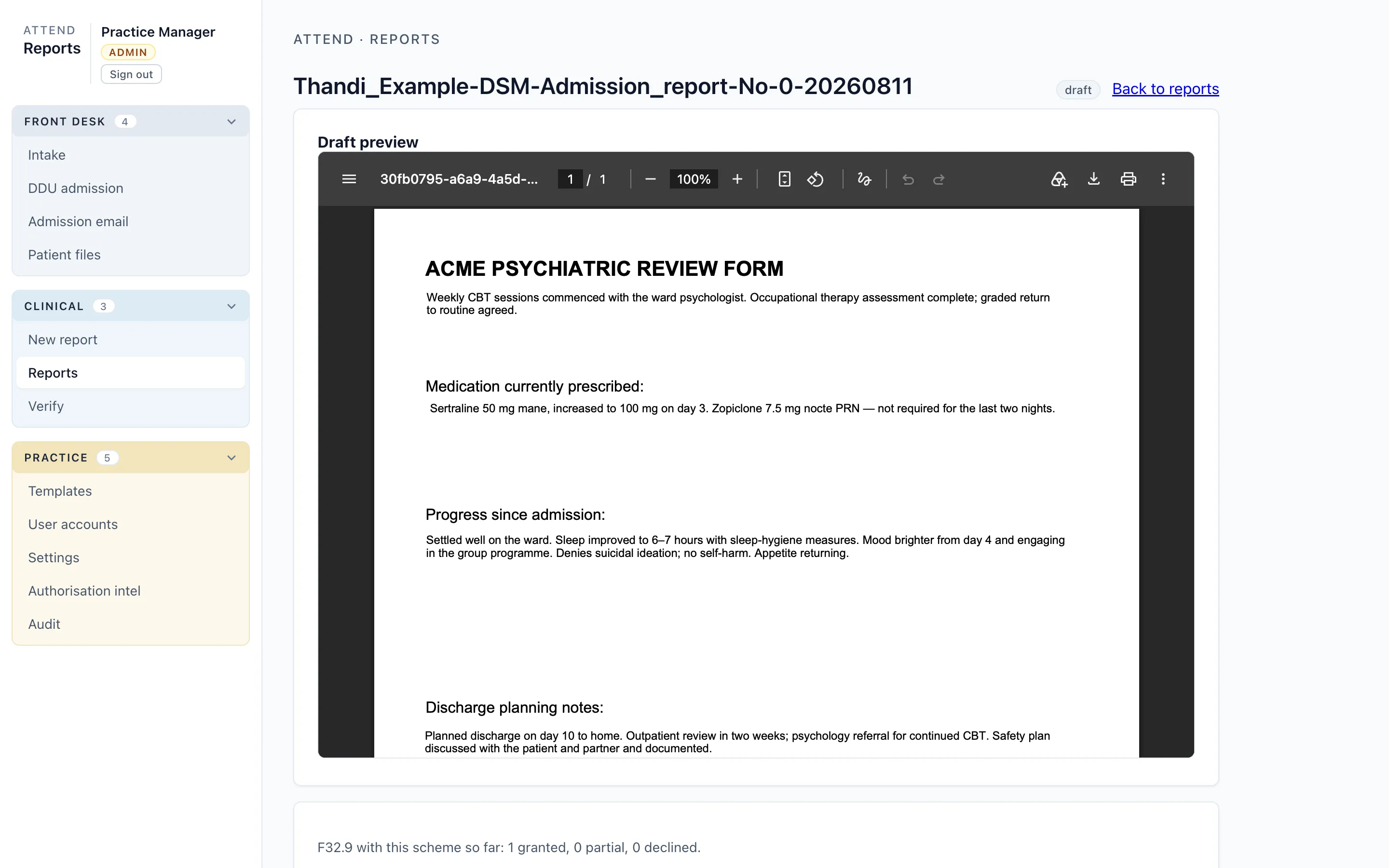
Every field stays editable in ATTEND, and again in Adobe Acrobat after export. Each report carries a unique identifier in its footer, so one version is never confused with an earlier or later one.
Learns from corrections
When a doctor changes a phrase, ATTEND notices. Corrections are reviewed and approved before they change how the next report is drafted, so the system converges on how the practice writes — and a reviewer can always see why a draft says what it says.
Fits the practice
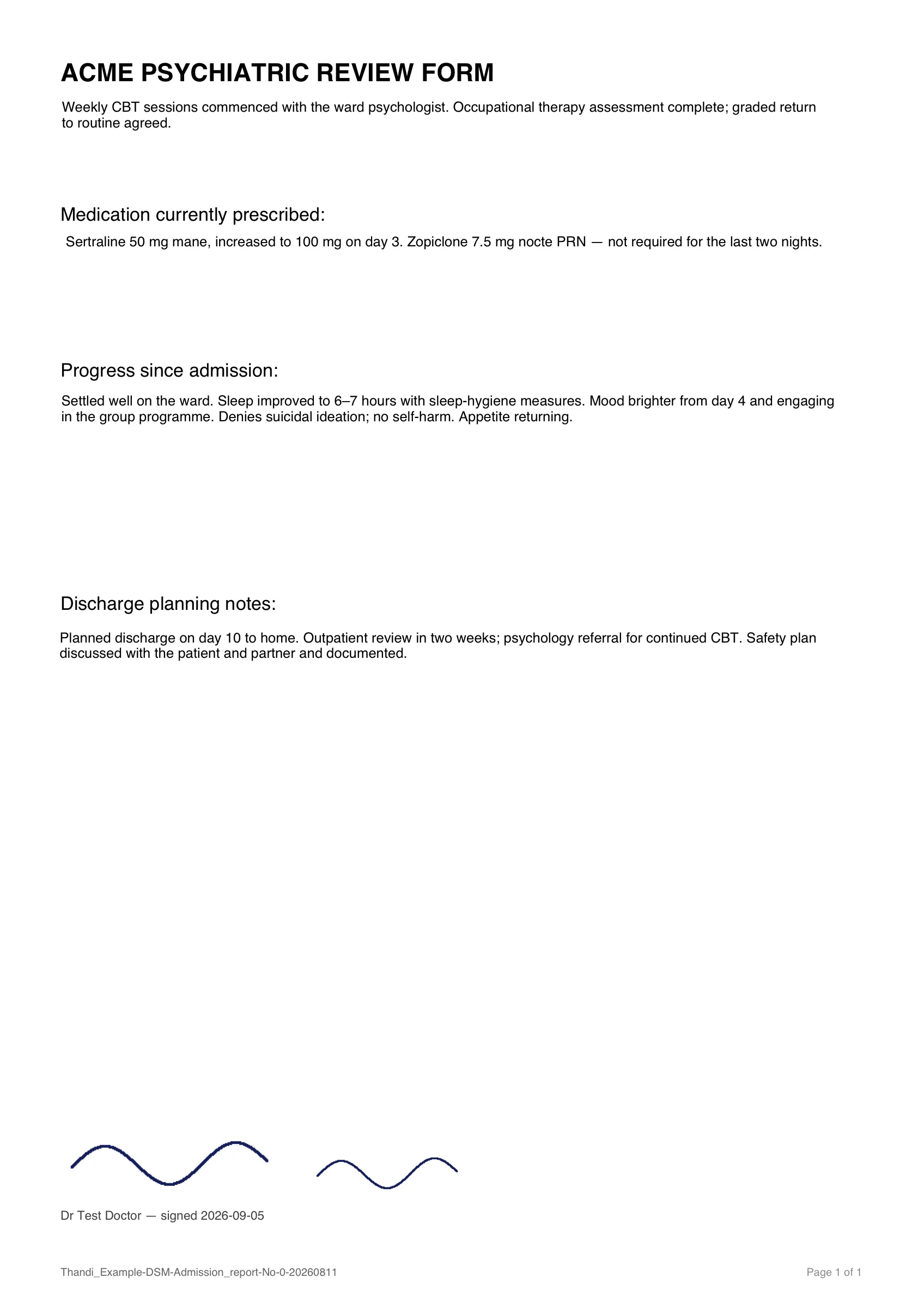
Templates are the practice's own forms, uploaded and published by the practice's administrator. Roles for doctors and staff, two-factor sign-in for everyone, and a plain PDF at the end that the hospital and the scheme already accept.
What the doctor sees
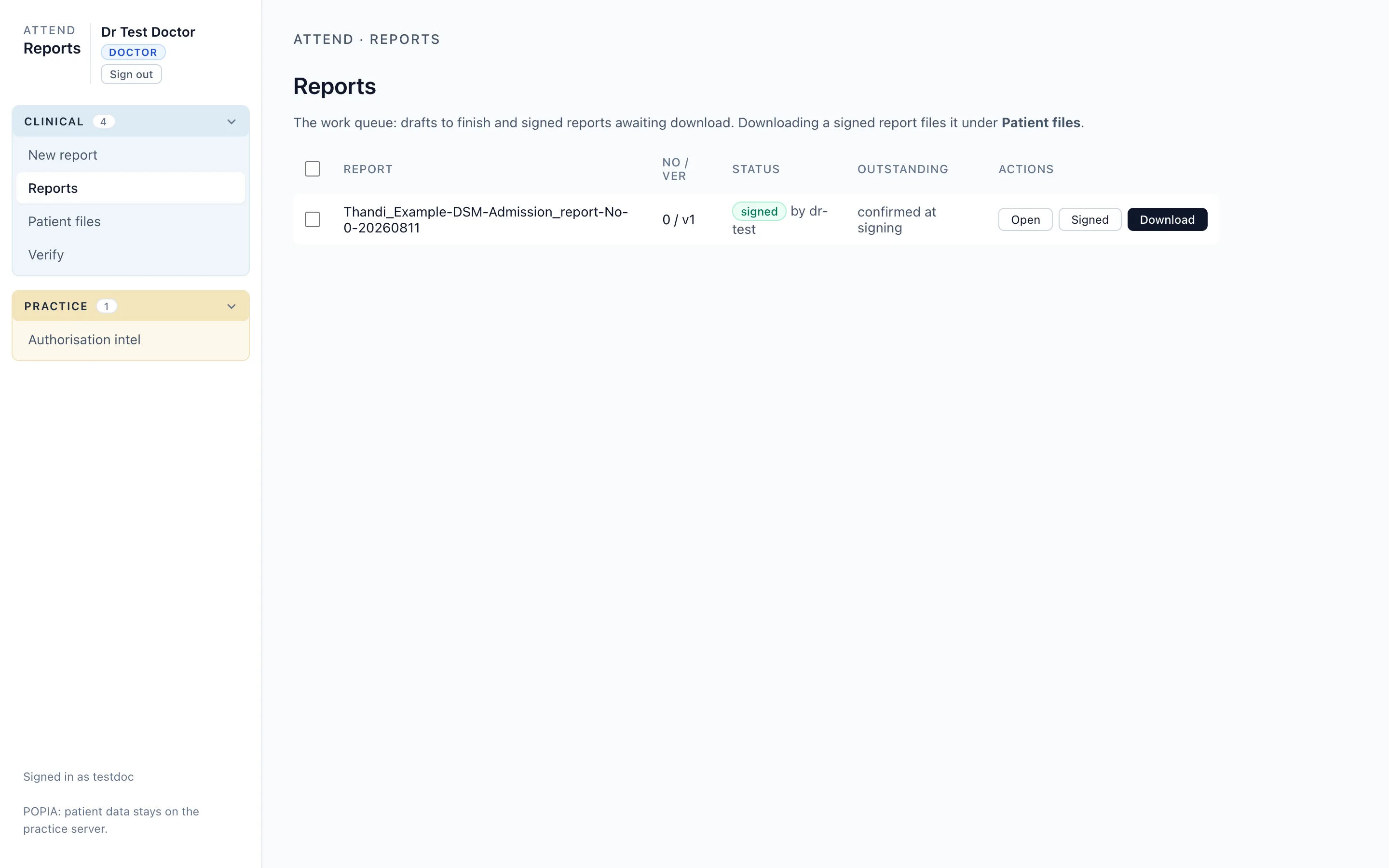
The report screen, the doctor's queue after signing, and the signed page as the hospital or scheme receives it. Everything shown is ATTEND running on fictional records.
How records are protected
Where records live
ATTEND is designed so that patient records stay in South Africa and each practice runs in its own isolated environment. Nothing in one practice's system can reach another's.
Who can see them
The practice's own doctors and staff, by role, behind mandatory two-factor sign-in. flowxscale processes records only as an operator under POPIA, under a written operator agreement with each practice.
What never happens
No patient content is sent to cloud AI without the patient's explicit consent. Identity numbers are never stored in the clear. And a practice is never locked out of its own records over an invoice — return of data on termination is written into every operator agreement.
Talk to us
Write to hi@flowxscale.com. We answer within two working days, and we demonstrate ATTEND on fictional records only.